
Recovery Isn't new. The Focus on Recovery Is.
The History of the Recovery Movement
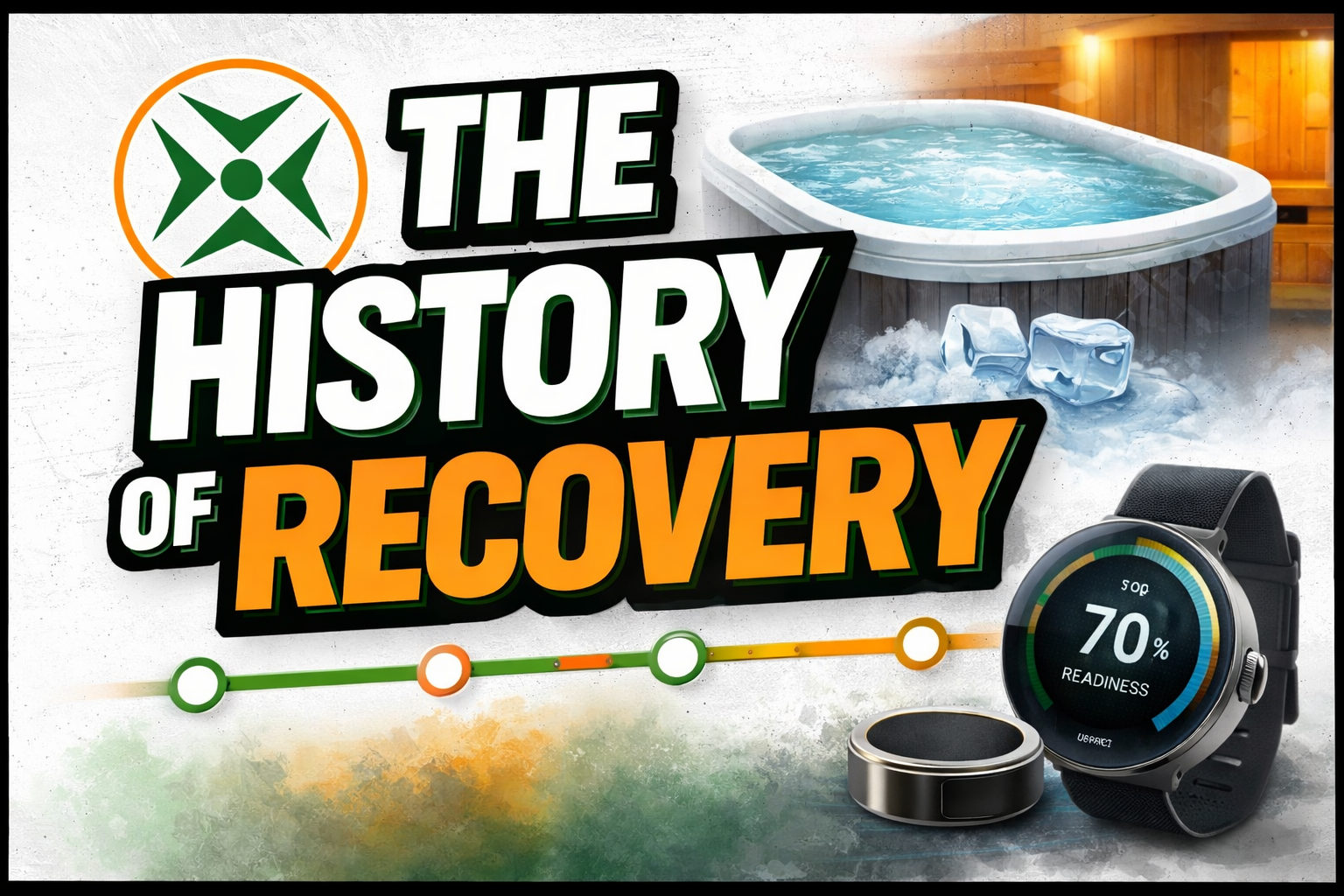
Walk into almost any gym today and you’ll see it: cold plunges, saunas, compression boots, sleep scores, HRV, “readiness,” breathwork, mobility classes, recovery studios in strip malls.
It can feel like recovery showed up overnight.
It didn’t.
Recovery has been part of training and human performance for well over a century. What’s changed is how necessary it has become—because the demands on athletes and adults have changed, and because technology and culture finally made recovery visible, measurable, and marketable.
This post is a story arc and timeline: how recovery evolved from common sense rest, to sport science, to burnout science, to wearables, to the modern “recovery economy”—and where we think it goes next.
Act 1 (Early 1900s): The Body Learns Stress Has a Cost
Before “recovery” was a buzzword, the conversation was really about stress—and the body’s reaction to it.
In 1915, physiologist Walter Bradford Cannon described what he called the fight-or-flight response, helping popularize the idea that the body has automatic survival gear that turns on under threat.
By 1936, Hans Selye formalized a model that still shapes how we talk about adaptation: the General Adaptation Syndrome—alarm, resistance, and exhaustion. In plain English: you can push stress for a while, but without enough recovery, the system eventually breaks down.
Even if you never read Cannon or Selye, this is the earliest “recovery” lesson:
Stress isn’t bad—unmanaged stress is.
And in the early-to-mid 1900s, “recovery” wasn’t a product. It was simply understood as rest between efforts.
Act 2 (1940s–1970s): Recovery Becomes Sports Science
After World War II, performance training became more systematic—especially in Soviet sport science. And this is where recovery starts to look like modern training theory.
1949–1959: Supercompensation enters the chat
Russian physiologist/biochemist Nikolai Yakovlev described the idea of supercompensation: after a training stress, the body rebounds and can temporarily rise above baseline—if the recovery window is right.
This was a huge shift: recovery wasn’t just “time off.” Recovery became the part of the process where improvement actually shows up.
1964–1965: Periodization becomes a planning system
Training theory then turns recovery into calendar math. Work by Lev Matveyev (often cited as a landmark) helped shape “classic” periodization—how to plan training cycles and recovery across weeks, months, and seasons.
1970s: Performance gets modeled
By the 1970s, sports science starts explicitly modeling the tug-of-war between fitness and fatigue, reinforcing the idea that you can’t interpret “more training” without accounting for recovery and accumulated fatigue.
So by the late 1900s, serious coaches already knew the truth:
The workout is the stimulus; recovery is the adaptation.
That idea is not new. What’s new is who needs it, how often, and how little margin people have.
Act 3 (1974–2019): Burnout Makes Recovery About Life, Not Just Sport
Now the story widens. Recovery stops being just a training topic and becomes a societal topic.
1974: Burnout becomes a term
Psychologist
Herbert Freudenberger described burnout in a clinical sense in 1974.
This matters because it reframes “recovery” beyond muscles and conditioning. It becomes about nervous system load, emotional depletion, and the cost of chronic stress.
1981: Burnout becomes measurable
Maslach and Jackson published foundational work on measuring burnout—one reason “burnout” became a mainstream concept rather than a vague feeling.
2019: WHO puts a flag in the ground
In 2019, the WHO included burnout in ICD-11 as an occupational phenomenon resulting from chronic workplace stress that hasn’t been successfully managed.
This is a key cultural pivot: recovery becomes less about “athlete extras” and more about basic operating health for working adults and students.
And the numbers made it harder to ignore. A widely cited Gallup finding from 2018 reported roughly two-thirds of full-time workers felt burned out at work at least sometimes (23% very often/always + 44% sometimes).
Act 4 (2000s–2010s): Training Intensifies and Youth Sports Go Year-Round
While burnout research expanded, training culture also changed.
The 2000s and 2010s were decades of intensity. “Harder, faster, more” became a badge of honor. And for youth athletes, sport became more year-round, more specialized, and more competitive.
The American Academy of Pediatrics (AAP) published a clinical report on sports specialization and intensive training in young athletes, reflecting growing concern about overuse injuries, burnout, and the risks of year-round specialization.
This is one of the biggest reasons recovery feels more relevant now than it used to:
The average athlete (and adult) is carrying a higher total load than prior generations.
Not just training load—life load.
Act 5 (2009–Present): Wearables Make Recovery Visible
The biggest accelerant for “recovery going mainstream” wasn’t a new discovery. It was measurement.
- 2009: Fitbit’s first tracker helps kickstart mass consumer wearables.
- 2015: Apple announces Apple Watch availability—wearables become truly mainstream.
- 2015: WHOOP releases its early product and explicitly frames tracking around strain, sleep, and recovery.
Once people could see sleep duration, resting heart rate trends, or readiness-style scoring, recovery stopped being a “coach’s intuition” and became a daily dashboard.
That did two things:
- It gave people permission to rest when the data looked bad.
- It also created a new kind of anxiety: optimizing instead of recovering.
Either way, it pushed recovery into everyday conversation.
Act 6 (Mid-2010s–Now): Recovery Becomes an Industry
When something becomes measurable and mainstream, businesses form around it.
Starting around the mid-2010s, dedicated recovery/wellness concepts scale rapidly: For example...
- iCRYO was founded in 2015 and expanded cryotherapy and related services into retail-style locations.
- StretchLab (founded 2015) grows assisted stretching into a boutique/franchise model.
- Restore Hyper Wellness (founded 2015) expands a “recovery menu” approach across many locations.
So now recovery isn’t just a principle—it’s a place you can go, a membership you can buy, a “stack” you can do.
That’s not inherently good or bad. It just means the market moved.
Act 7 (2020–2022): COVID Changes the Baseline
COVID didn’t invent burnout or recovery. It raised the baseline stress level for a lot of people—parents, teens, coaches, executives, everyone.
On the work side, remote work changed patterns fast. Microsoft research during the pandemic found shifts toward more asynchronous communication like email/IM and changes in collaboration patterns.
Media coverage of Microsoft Teams data highlighted the feeling many people had: more meetings, more chats, more digital overload.
On the sport side, schedules got disrupted, then compressed, then intensified—often with less true downtime.
The result: recovery stopped being “nice.” It became a necessary infrastructure for staying consistent.
So, Why Is Recovery More Prominent Now?
Because the modern environment creates a perfect storm:
- Higher total load: training + school/work + screens + stress
- Less true downshift: constant stimulation, late-night light, constant comparison
- More year-round sport: earlier specialization, more competition, more pressure
- More measurement: wearables turned recovery into daily data
- More access: recovery studios and modalities moved from pro locker rooms to Main Street
Again: recovery isn’t new. The need to prioritize it is what has escalated.
The Prototype View: Recovery Isn’t a Service. It’s a Prescription.
Here’s where we draw a hard line, because it matters for your results.
We don’t treat recovery like a spa add-on. We COACH it... it's layered into training routines.
We treat recovery like training:
prescribed, timed, and matched to the goal.
That means two things:
- We start with fundamentals.
Sleep, nutrition, movement, stress management—because no amount of sauna or cold plunge can outwork the basics. - We use tools strategically, not emotionally.
Modalities are enhancers. Used well, they can help you downshift, manage soreness, and stay consistent. Used poorly, they become noise—or they mask the real issue (training load, lifestyle load, or poor planning).
And this is the connection that matters for your community:
“The needs of Olympic athletes and our grandparents differ by degree, not kind.”-Greg Glassman (Founder of CrossFit)
A high school athlete chasing dominance and a parent building competence live on the same continuum—same human system, different dose.
Same arena. Same principles. Different expression.
A Simple Timeline Recap:
- 1915: Cannon describes fight-or-flight
- 1936: Selye’s stress/adaptation framework
- 1949–1959: Yakovlev + supercompensation
- 1964–1965: Matveyev + periodization planning
- 1974: Freudenberger + burnout
- 1981: Maslach & Jackson measurement work
- 2009: Fitbit helps launch mass wearables
- 2015: Apple Watch goes mainstream; recovery wearables rise
- 2015: Recovery studios scale (iCRYO/Restore/StretchLab)
- 2016: AAP addresses specialization/intensive youth training risks
- 2019: WHO classifies burnout in ICD-11
- 2020–2022: COVID-era work and life patterns increase load/overload
Closing: The Point Isn’t Recovery. The Point Is Results.
The goal isn’t to “do recovery.” The goal is to perform—and keep performing—without breaking down.
That’s what we’re building at Prototype Training Systems: a place where kids and parents can train and grow in the same arena, guided by coaches who understand that adaptation isn’t earned by effort alone.
It’s earned by effort + recovery, applied with judgment.
References & Further Reading
- Cannon, W.B. — Fight-or-flight response (background on Cannon and the concept)
Encyclopaedia Britannica: Walter Bradford Cannon
https://www.britannica.com/biography/Walter-Bradford-Cannon - Selye, H. (1936) — General Adaptation Syndrome (stress → adaptation → exhaustion)
Open-access overview (Penn State Kinesiology OER)
https://psu.pb.unizin.org/kines082/chapter/selye/ - Viru, A. / historical Russian sport physiology context — Yakovlev + early supercompensation history
SportBiochemistry.com (historical overview)
https://sportbiochemistry.com/articles/Viru_historical_Russian_physiologists.htm - Matveyev, L.P. (classic periodization) — Historical discussion of Matveyev and periodization
HRČAK (Croatian scientific portal) PDF
https://hrcak.srce.hr/file/188747 - Freudenberger, H.J. (1974) / Burnout history overview
BMJ feature: Burnout: a history
https://www.bmj.com/content/363/bmj.k5268 - Maslach & Jackson (1981) — Foundational burnout measurement work
JSTOR record page
https://www.jstor.org/stable/3000281 - WHO (2019) — Burn-out in ICD-11 as an occupational phenomenon
World Health Organization announcement
https://www.who.int/news/item/28-05-2019-burn-out-an-occupational-phenomenon-international-classification-of-diseases - American Academy of Pediatrics (AAP) (2016) — Sports specialization/intensive training risks in youth
Pediatrics clinical report
https://publications.aap.org/pediatrics/article/138/3/e20162148/52612/Sports-Specialization-and-Intensive-Training-in - Fitbit (company background / early wearables timeline)
Wikipedia overview
https://en.wikipedia.org/wiki/Fitbit - Apple (2015) — Apple Watch launch availability announcement
Apple Newsroom (primary source)
https://www.apple.com/newsroom/2015/03/09Apple-Watch-Available-in-Nine-Countries-on-April-24/ - WHOOP (company background / recovery scoring concept context)
Wikipedia overview
https://en.wikipedia.org/wiki/WHOOP_(company) - iCRYO (founded 2015; recovery studio model scaling)
iCRYO “About” page
https://icryo.com/about/ - StretchLab (founded 2015; assisted stretching scaling)
Franchise.com listing (business overview)
https://www.franchise.com/franchise/stretchlab - Restore Hyper Wellness (founded 2015; recovery studio category growth)
Athletech News coverage (category / market context)
https://athletechnews.com/wellness-recovery-outlook-ceos-talk-market-growth-making-science-accessible/ - Microsoft Research (remote work effects on collaboration; pandemic-era load)
The effects of remote work on collaboration among information workers
https://www.microsoft.com/en-us/research/publication/the-effects-of-remote-work-on-collaboration-among-information-workers/ - Digital overload / pandemic-era communication load
Axios: Quantifying digital overload for workers during coronavirus
https://www.axios.com/2021/03/23/quantifying-digital-overload-workers-coronavirus - Workplace burnout prevalence (Gallup-reported numbers commonly cited)
HRMorning whitepaper summarizing Gallup findings
https://www.hrmorning.com/wp-content/uploads/2022/05/Whitepaper-The-Burnout-Epidemic.pdf
Previous Blogs


Climb to New Heights
Prototype Training Systems is more than a gym - it is a lifestyle. Join us today!