
Coach Tony Pittman | 100 in 100: Day 16 | Prototype Training Systems
100 in 100: Tony Pittman-Day 16 (Memorial Day Edition)
Mike Collette • May 25, 2026
Prototype Training Systems Presents
100
IN 100
IN 100
Member Stories
100 Days · 100 Stories
Day 16 · Memorial Day · May 25, 2026
Coach Tony Pittman
20 Years of Service. An American Hero. And a Community That Helped Him Heal.
The Kid Who Knew
Most kids in 3rd grade are thinking about recess. Tony Pittman was writing letters to soldiers.
Growing up in Attleboro, Massachusetts, Tony had a pen pal in the Gulf War. He was 8 or 9 years old, reading letters from men who were halfway around the world — men who were passionate about what they were doing, men who were consciously putting something bigger than themselves first. It stuck.
"I could tell they were passionate about what they were doing," Tony says. "And they were consciously putting something bigger than themselves first. I wanted to join and do my part."
He enlisted in the Army out of high school in September 1999. Combat engineer. Specialized in demolition and wartime construction. He was planning to do three years — serve his country, come home, figure out civilian life. Then September 11th happened.
"Three days after 9/11, I reenlisted. I didn't want to leave the people I was training with."
— Tony PittmanHe was across the country when the towers came down. Three days later, he reenlisted. Not because someone told him to. Not because he didn't have a choice. Because he wasn't willing to leave the people beside him. A year and a half later, he was in Iraq.
Twenty Years, Six Deployments, Twenty-Two Countries
After Iraq, Tony transitioned to Civil Affairs — a world apart from demolition, but no less demanding. Civil Affairs is special operations. The job: liaise between civilians, host-country militaries, US embassies, and local governments — from village level all the way up to heads of state. Most of the time, they were in a place because bad guys were there. They built communities to be more secure. They removed threats. They did both at once.
Over the next fifteen years, Tony rose through the ranks — Team Sergeant, First Sergeant, Operations Sergeant Major, and ultimately Command Sergeant Major of the only active component Civil Affairs Battalion in the US Army, supporting special operations forces across five Geographic Combatant Commands simultaneously: Pacific, Southern, Africa, Europe, and Central Command.
"We tied civil planning and tactical planning together," Tony says. "You're building something and fighting for it at the same time."
He did five more combat deployments after Iraq. Six total. Twenty-two countries over twenty years. Most soldiers see one or two combat deployments. Six is rare. Every time he came home, something pulled him back.
"We were in such a high op tempo. I never wanted to leave the people I trained with."
— Tony PittmanThat answer — the people — shows up every time you ask Tony why he did anything. Why he reenlisted. Why he kept going back. Why he's standing on the floor of a gym in Westborough coaching a Tuesday evening class. It's always the people.
CrossFit Before CrossFit Was a Thing
Tony found CrossFit in 2005 or 2006. Not in a box gym. Not through a YouTube video. In the field, during a deployment, when someone in his unit taught them the basics — and then they went after it.
Civil Affairs special operations meant working alongside Navy SEALs — Naval Special Warfare Platoons, Special Forces ODAs, host-nation forces. They'd invite guys from different units to join their workouts. They loved the company and the shared suffering.
"We didn't follow the WOD hero workouts back then," Tony says. "It was mostly guys coming up with brutal workouts."
One of those workouts happened during Operation Enduring Freedom Philippines — OEF-P — at a camp called Fuego Fuego near the Marine base on the island of Basilian. There was a pier. A channel. A small island on the other side. The workout: 400 meter run, swim across the channel, pull-ups, push-ups, and dips on trees, swim back, then max reps bench press at 135 pounds. Three rounds. Thirty to forty minutes.
They always invited whoever they were working with — Philippine Marines, Afghan National Army soldiers. Competition and connection, at the same time.
"We'd always invite the different orgs we were with," Tony says. "We wanted to show them how fit we were."
That spirit — training hard, building trust through shared suffering, welcoming people into the work — would follow Tony out of the Army, through a gut surgery, through a bilateral patella rupture, and eventually into a gym on East Main Street in Westborough.
527
Sign-Ins at Prototype
6
Combat Deployments
22
Countries Deployed To
20
Years of Service
300
Bench Press 1RM (lbs)
500
Deadlift PR (lbs)
Getting Out, Getting Lost
Tony retired from the Army in 2019 after twenty years of service. He thought he knew what civilian life looked like: work as much as possible, make as much money as possible. So that's what he did.
What he missed — what he didn't realize he'd been running on for two decades — was the camaraderie. The shared mission. The people.
"I missed the camaraderie," Tony says simply. "That's what I didn't have."
For years after getting out, Tony hadn't addressed what he'd carried home from service. PTSD is common among combat veterans. It's also common to not talk about it, not treat it, not name it — to put on a face like there's no problem and keep moving.
"I struggle a lot with PTSD. I can easily put on a face like there's no problem. But there's always some pain in the background."
— Tony PittmanApril 2024 was when something shifted. Tony got his CrossFit Level 1 certification — partly to get his own fitness back in line, partly because he wasn't sure what else to do with the restlessness. He enjoyed it so much that two months later, he walked into his employer's office and told them he was leaving.
He committed the next six months to two things: his fitness, and his mental health. For someone who'd spent twenty years putting everyone else first, both were harder than any workout.
"Up to that point, I had never done anything to help myself with PTSD," Tony says. "I took that six months to focus on fitness and address my own issues from service — to transition the way I should have."
Then he walked into Prototype.
July 8, 2024
Tony had just come off gut surgery. He wasn't in the shape he wanted to be in — not by his own standard, not by the standard of someone who'd spent twenty years as one of the fittest people in every room he was in. It was humbling in a way that was hard to sit with.
But he walked through the door at 50 East Main Street, and something happened immediately.
"Peg was the first one to make me feel welcome," Tony says. "Everyone was so welcoming. I knew this was going to be a new home."
He started at the 9am class. Then he started coming more. Then his community within this community started to grow — the 5am crew, the open gym regulars, the people who show up even when it's hard.
Five months after walking through the door, he was named the 2024 Prototype Rookie of the Year.
Spartan Fenway
— Tony repping Prototype on the race course. The community that found him on July 8th didn't take long to become part of his identity.
In his own words from his Prototype of the Month write-up, early in his time here: "PTS is a team. The people make it fun. The workouts are challenging while the community and social support make it fun. I really enjoy that PTS is more than workout sessions."
The camaraderie he'd been missing since 2019 — the "shared suck," as he calls it, that binds people together — he found it again. In a place he didn't expect. Doing something that felt familiar in the best possible way.
The Softball Game That Almost Ended Everything
Tony's knee had been through it before. He tore his patella tendon three times during his service — in Iraq in 2007 when he hyperextended it running into a pothole while under fire, once jumping out of a plane, once missing a step in a training building with full gear on. Each time it came back, it came back bigger. His strategy became: build as much muscle as possible to protect what's left.
It was working. He started competing in powerlifting at the end of 2024. His deadlift climbed. His bench press climbed. He was competing in the RPS at the end of 2025.
Then in April 2025, at the bottom of a squat, he felt his knee shift. Something felt wrong. He gave it a rest, waited to see his doctor.
On May 4, 2025, rounding the bases in a softball game, Tony ruptured both patella tendons at once.
"As it started setting in, I didn't know what I was going to do. I didn't want to lose any of the fitness gains I'd made since leaving the service."
— Tony PittmanHe was in the ICU. He got bands from Prototype while he was there. He started doing band work from his hospital bed. He missed two workout days. That's it.
ICU. Day two.
Tony joined the 9am class virtually from his hospital bed — bands, bilateral rupture, and all. Two missed workout days. That's it.
"I lost two workout days and that's it," Tony says. "I had to modify significantly. But I found a different way."
When he got home, depression set in. The injury layered on top of everything he was already carrying. But then the community here showed up — literally. People came to his house with food. Jon Davis picked him up and drove him to the gym. Gillian and Jon pushed him to get out of the house and come in.
"That was huge for my recovery," Tony says. "Moving, not missing workouts. That's a big part of why my recovery went so quickly."
End of May — back in the gym once a week, on crutches, helping out at Lift Off 2025. June — in PT twice a week, back at Prototype twice a week. He could barely walk. Middle of June, off the crutches. July — first deadlift, not heavy, but there. August — first squat with a bar. From there, everything turned around.
First day back.
Post-surgery, weeks after the bilateral rupture — back on the floor at Prototype. The comeback started here.
At Lift Off 2026 — one week short of a year from the rupture — Tony tied his deadlift PR at 500 pounds.
The Coach
At the end of 2024, Jon asked Tony to coach. Tony was blown away that he'd ask.
He shouldn't have been. He retired as a Command Sergeant Major — the highest enlisted rank in the US Army, and one of the most demanding leadership roles in the military. For eighteen of his twenty years of service, he was leading soldiers, developing NCOs, shaping doctrine, and building units. That doesn't just switch off.
"In the military, you get to influence people's lives in a positive way," Tony says. "When I started coaching, a lot of that stuff came back. I realized how much of a positive impact I can have on building positive relationships with people, and the trust you build with people. For me, that was life-changing."
Tony coaches LTAD — the youth program — three days a week. He says the kids remind him exactly of new guys coming into the military: young, hungry, want to get after it, but don't know how. Push hard in the right or wrong direction.
"Kids this age are sponges," Tony says. "If you treat them right, they will be better people all around. Not just better athletes. Better people."
Earned.
Tony with Damon after completing Prototype's 30 Day Hard challenge — one of only a handful of members to finish it. The standard he holds himself to is the same one he brings to the floor every day as a coach.
He also coaches group classes Tuesday through Friday evenings and open gym on weekends. And recently, he wrote something to one of the other coaches here that captures his entire philosophy in a few sentences:
"This is a great example of how people respect your position as coach. You get through to them on training and on a personal level, human to human. Their guard comes down and they make some friends in the process. Remember — a lot of people will always be watching to emulate your example."
Tony knows that. He's been living it since he was a second-year soldier in the Army. He's living it now, every time he walks onto this floor.
Why Tony Trains
"Fitness and the relationships you get through fitness — the camaraderie you build, the shared suck, where we all come together and the commonality we have versus the differences — that is uplifting. It doesn't matter if it's a 500 pound PR or a 5 pound PR. It's just as exciting."
Memorial Day
Tony knows people who aren't here anymore. Names and faces, not just a concept. That's what makes today different for him than it might be for most of us.
"It's a sad day because I know people who are gone. But it's a happy day because this country wouldn't be where it is without those people. So we get to have that hot dog."
— Tony Pittman"All the men and women who gave their lives to this country put their priority for others," Tony says, "so that everyone here can live the life they live. We need to show them the respect and celebrate their lives and their dedication to this country above all else."
He doesn't put conditions on it. No religion, no politics, no gender. "We're all Americans on this day," he says.
From a kid in Attleboro writing letters to soldiers, to becoming one, to twenty years of service, to finding his way back to himself through fitness and this community — Tony Pittman has earned the right to say that. Every single word of it.
Start Your Story — Book a Free Intro
No pressure. No commitment. Just a conversation.
A Note from Mike
Tony Pittman is one of the most remarkable people I've had the privilege of knowing — and I don't say that lightly. When he walked through our doors on July 8th, 2024, he was coming off gut surgery, working through the PTSD that twenty years of service had left behind, and looking for something he hadn't been able to name yet. He came in as a Command Sergeant Major — the highest enlisted rank in the US Army — who had led soldiers across five combatant commands, shaped doctrine that scaled across an entire war, and never once asked for anything in return. And he walked into our 9am class humbled, ready to work, and genuinely grateful that Peg said hello.
What he found here is what we try to build every single day: a community where the standard is high, the welcome is genuine, and nobody has to carry their stuff alone. Peg made him feel welcome first. Then the 5am crew. Then the coaches. Then, when he was lying in a hospital bed after a bilateral patella rupture with bands around his legs, the whole community showed up at his door.
That's Prototype. That's what we're building here.
Tony is now one of our coaches — and he's exactly the kind of coach this place deserves. He leads with service, teaches with patience, and shows up every single day. On Memorial Day, I want to say something I don't say enough: thank you, Tony. For your service to this country, for what you bring to this community, and for trusting us with your story.
To everyone reading this today — take a moment. Honor the ones who aren't here. Then go live the life they made possible.
— Mike Collette, Founder & CEO, Prototype Training Systems
See All 100 Stories →
100 Days · 100 Members · One Community
A note on this story: Tony's story was developed from a recorded interview and verified member data. Narrative copy was drafted with AI assistance and reviewed for accuracy. All quotes reflect Tony's own words. Stats sourced from Prototype Training Systems member records (Wodify/Mission Control, May 2026).
Previous Blogs
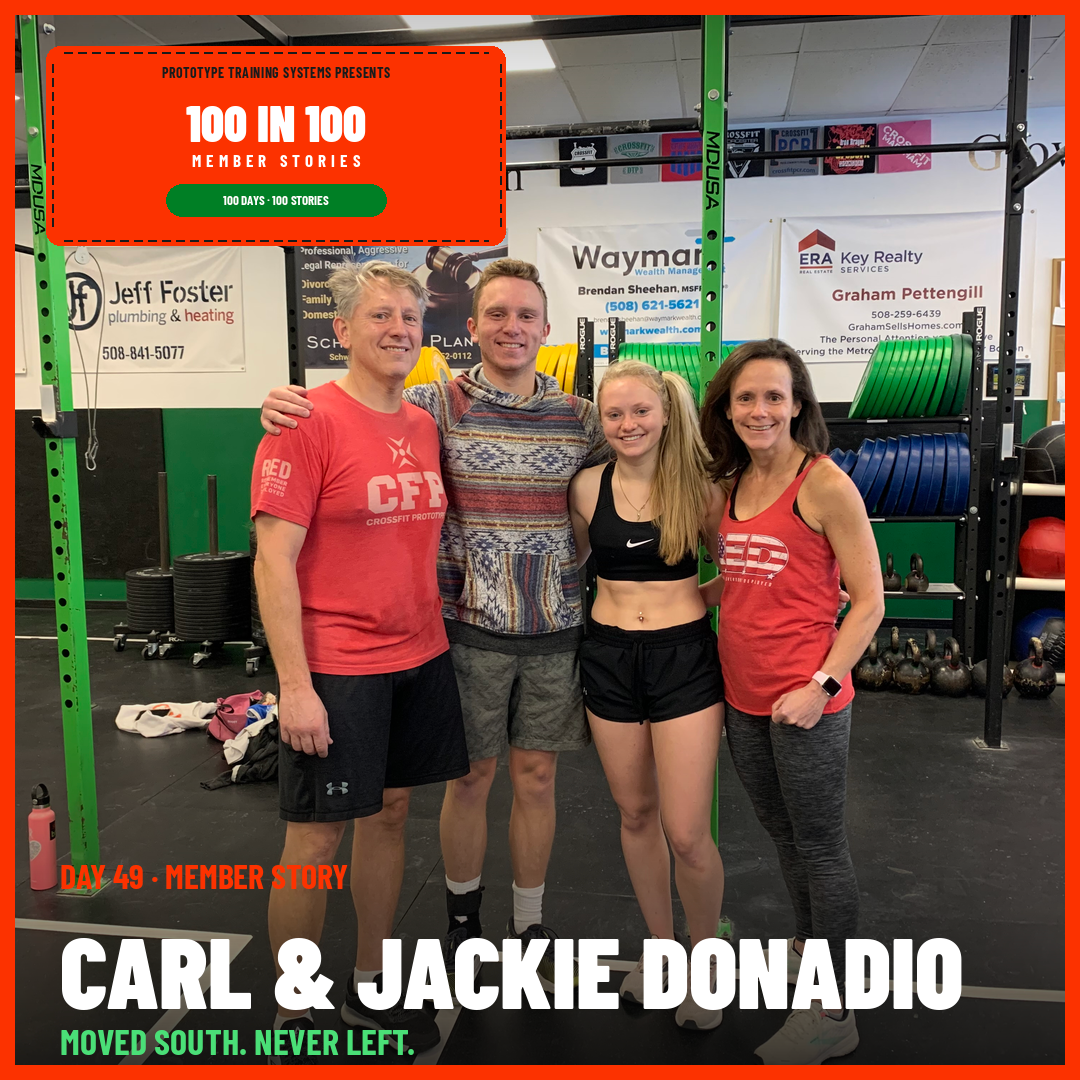
Carl & Jackie Donadio moved to South Carolina years ago. Ten years of Prototype didn't stay behind.
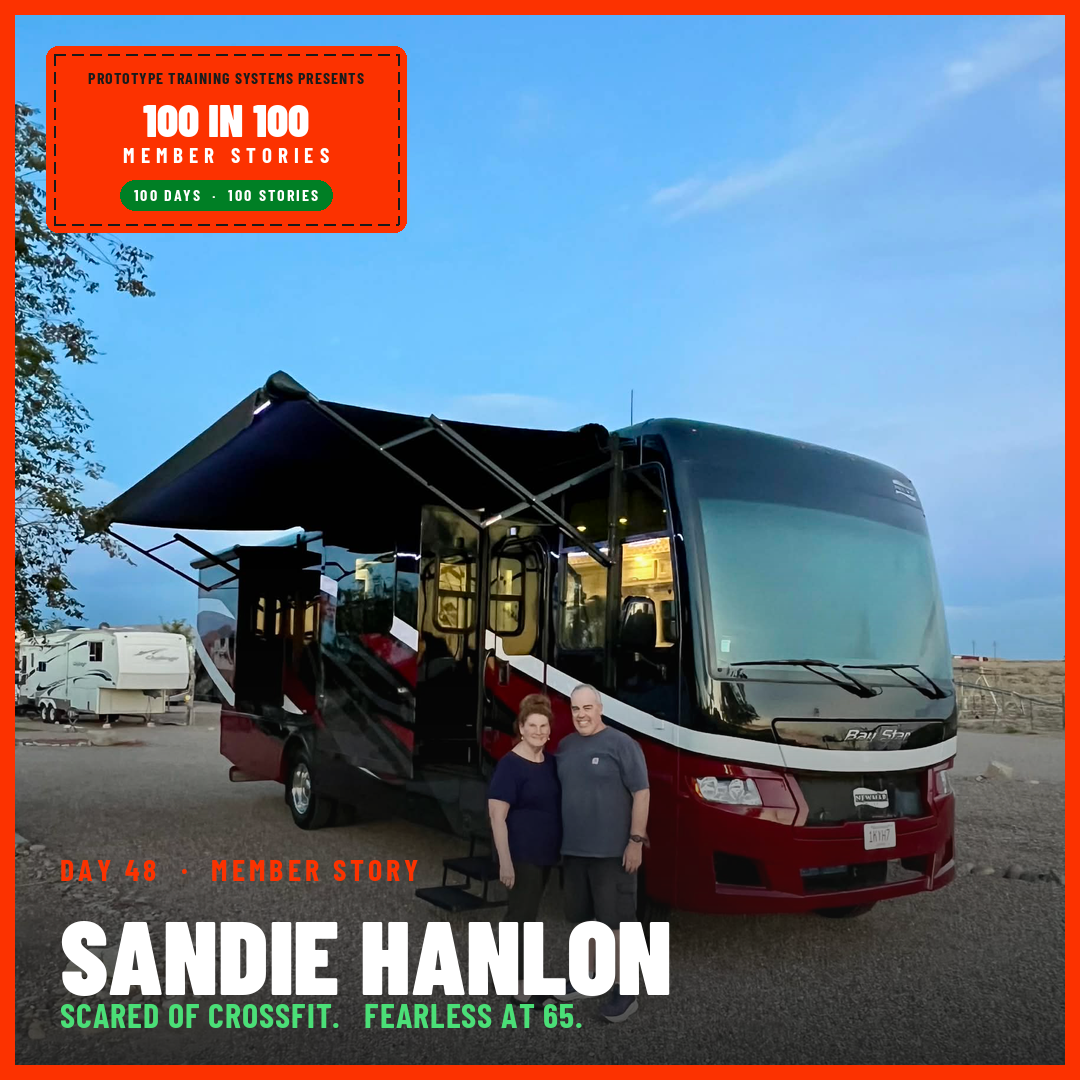
Before Prototype existed, Sandie Hanlon was already there. 13 years, 1,291 workouts, and a deadlift that's grown from 65 to 165 lbs.
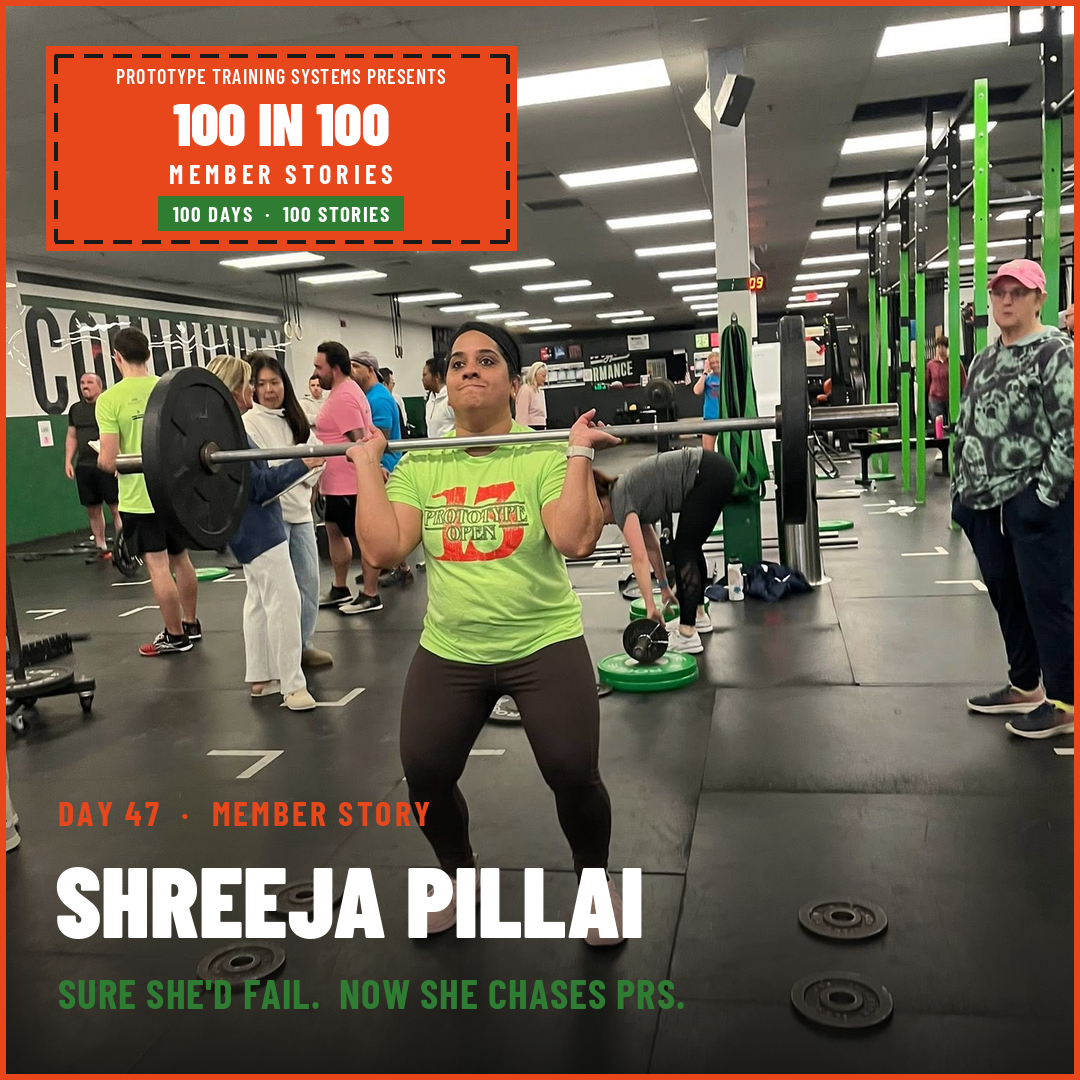
Shreeja Pillai had never done CrossFit and was sure she'd fail her first class. Two years later she's chasing PRs — and training beside her son.
Climb to New Heights
Prototype Training Systems is more than a gym - it is a lifestyle. Join us today!