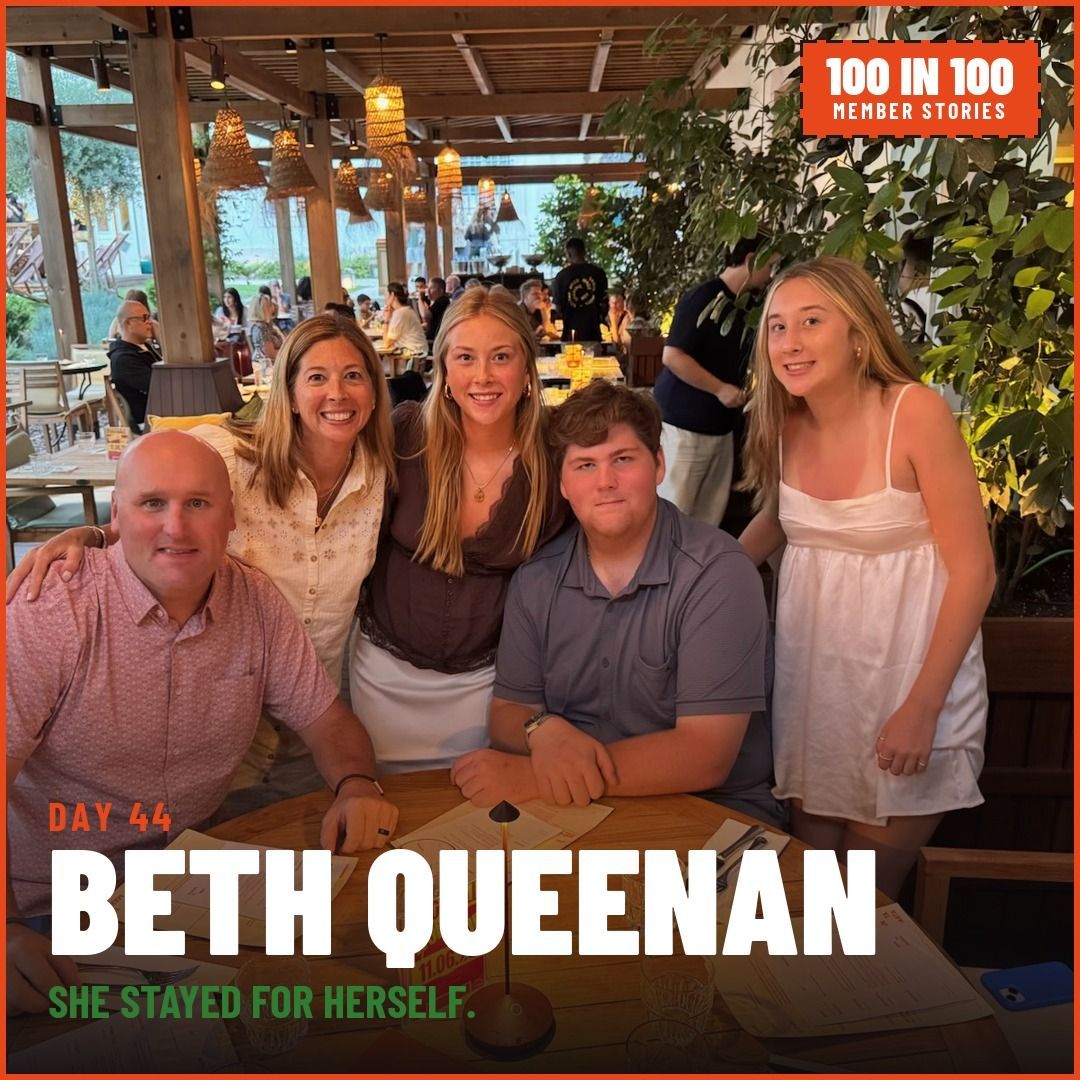
Caroline Queenan walked into Prototype for the first time near the end of her sophomore year — not because she went looking for it, but because her family was already here. Her brother Jack had been training with Coach Steve for years. Her mom had started coming too. One day, her mom brought her along.
That was all it took.
"Right away I knew this was my place," Caroline says. "I never really knew there were places this cool — otherwise I would have come sooner."
Already Working. Just Missing the Right Environment.
Before Prototype, Caroline was never sitting still. She was a high-level soccer player — a midfielder chasing a college roster spot — and someone who pulled up YouTube videos in her bonus room to find new workouts on her own. She was already putting in the work. She just didn't have a system, a coach, or a community around it.
Prototype gave her all three.
Since her first sign-in in May 2024, Caroline has logged 364 training sessions — 265 of them one-on-one with Coach Steve Cimino. That's not a casual gym membership. That's a development relationship built rep by rep across nearly two years. The work shows: League MVP honors, 2x All-State, 3x All-Star, 3x Team MVP, captain of FC Stars 2024, and Senior Captain of the Westborough Girls Varsity team. And it shows in what came next — a commitment to Saint Anselm College to play soccer and study Health Science.
"Beyond the physical side, I've learned so many lessons here that you can't get anywhere else."
— Caroline QueenanThe First Athlete to Go All In on Mental Performance
Caroline is the first athlete at Prototype to go through a full mental performance coaching program — 52 weeks of structured weekly reflections, OMM entries sent to Steve, AI-assisted coaching loops, and a development process that tracked the mental game the same way the weight room tracks the physical one.
It started simply: Steve asked her to write down what was on her mind each week. She did. And over time, those entries became something more — a record of how she thinks, how she handles pressure, where she gets stuck, and how she grows. Nine InBody scans. A full year of training data. And 52 reflections that charted territory most athletes never put into words.
"In this kind of stuff it is hard to tell what's getting better and what's not because there's no number like in a workout — but when I wrote out my reflections and thoughts it's easier to tell."
— Caroline Queenan, March 2026That insight — that reflection is how you measure mental growth — is what the whole program was built on. And Caroline was the one who proved it could work.
Training the Mind Like the Body
The physical growth over those 19 months is real. Nine InBody scans across the program tell a consistent story of progressive development. Her hip thrust more than doubled. Her front squat more than doubled. The body she built for college soccer is measurably different from the one she walked in with.
But the mental growth is what makes this story different.
Early in the program, Caroline's reflections were full of self-criticism — the word "should" appearing again and again. "I didn't feel as confident as I should've." The standard always slightly out of reach. Steve's coaching reframe was direct: most workouts you'll be at 70%. Some days 40%. Consistency is what pays off — not perfection.
By March 2026, something had shifted. Where early entries read "I don't know why but..." — uncertainty as a dead end — her recent entries read "I noticed in myself..." — uncertainty as a starting point. Passive framing gave way to active. "Things happen to her" became "she names her role and her choices."
"Your brain is a muscle — you have to train it like a workout," Caroline says. "You won't get mentally stronger by doing the same things. You have to find new ways to push yourself."
Adding Language to What She Was Already Building
In February 2025, Caroline attended a Next Jump Leadership Academy — a two-day intensive with coaches, athletes, and professionals from different fields. It wasn't a turning point so much as a bridge — a place where she picked up language and frameworks for things she was already experiencing at Prototype.
One idea that connected: 85% of performance is emotional, 15% physical and chemical. "This blew my mind," she wrote. "I've always focused on the physical and chemical aspect of the body thinking I was doing a lot when I didn't take enough time to focus on the emotional side."
She brought what she learned back to the younger athletes she coaches at Prototype — another rep of the same pattern: take something in, process it, then teach it to someone else.
"Your brain is a muscle — you have to train it like a workout. You won't get mentally stronger by doing the same things. You have to find new ways to push yourself."
— Caroline QueenanBuilding Through the Hardest Chapter
In November 2025, an MRI confirmed a near-complete ligament tear in her ankle. For an athlete in the middle of a college soccer commitment and a senior season, it was the kind of news that could derail everything.
It didn't.
What the InBody data shows is striking: January 2026 was the lowest muscle mass reading of the entire program — the injury's direct impact visible in the numbers. By March 2026, it was fully restored. And March 2026 — the highest-uncertainty month of the entire program — was also her highest training volume month. When the field wasn't available, the gym became where she exerted control.
On February 25, 2026, she ran for the first time post-injury. Her reflection that day: "Running today felt really big for me. I think it was more of a mental breakthrough than physical to be honest."
She played her first game back on April 18. Her log: "First game back in 5 months! Was exciting to play and I think I did well."
The patience she'd been building in her weekly reflections — learning to respond rather than react, to trust the process rather than force the outcome — turned out to be exactly what the injury required.
From Being Coached to Doing the Coaching
Somewhere along the way, Caroline stopped being only the athlete being developed — and started being the person doing the developing.
She noticed coaches like Gaby and Owen working with younger athletes and found herself curious about doing the same. She loved working with other athletes. So she started — first at Nike Soccer Camps, then in LTAD sessions and youth fundamentals classes. Steve forwarded one of her LTAD reflections to the full staff after reading it. In it, she wrote:
"After coaching more classes I've also noticed a difference in myself when it comes to giving feedback and teaching. Normally, that would've been really hard for me, especially since she's older and my friend. But it came naturally this time, and I think it's because I've been getting so many reps coaching the younger kids."
The mental performance work accelerated the coaching. Every time she helped someone else process a hard thing, she learned something about herself. In July 2025, coaching a younger athlete through frustration, she reflected: "As soon as she was telling me her frustrations I immediately could come up with better ways to think about it. But there are lots of situations where I miss those moments for myself — recognizing other people's moments made me more aware I've had those similar thoughts before."
"Seeing LTADs progress each week is so motivating and rewarding," she says. "Realizing everyone needs to be coached a little different to be the best version of themselves. There's not always one right answer."
Coaching Runs in Both Directions
The instinct to help people move and grow doesn't stop at the gym door. Caroline has built a personalized training program for her grandparents — both over 80, neither with much of a workout history. She writes their sessions, checks in regularly, and adjusts as they go.
Nine weeks in, on a five-day-a-week program, they haven't missed a single workout. Glucose levels improved. Blood pressure improved. They're walking straighter. But that's not what keeps Caroline coming back to it.
"My favorite part is just being able to talk to them more and see them more," she says. "The little check-ins, hearing how their workout went — that's what's inspiring to me. If they can show up every single day at over 80 years old, that motivates me to think about who I want to be when I'm older."
It's the clearest expression of what coaching means to her: find out what matters to the person in front of you, build something specifically for them, and show up consistently. The age of the athlete doesn't change the approach.
The Full Cycle
In a May 2026 reflection, Caroline wrote: "I have already learned so much these few weeks and I finally realized how important it is to choose work you get excited to go to every day. I always look forward to coming in — it has made me happier, more motivated, excited to learn, and less stressed."
She described watching a parent talk about how a shy LTAD athlete had transformed — socially, emotionally — through their time at Prototype. Then she wrote: "This is what makes Prototype more than a gym!"
That's the full arc. She came to get faster and stronger for soccer. She did. But she also became the first athlete at Prototype to go through a full mental performance program — and in doing so, helped prove that the physical and mental aren't separate tracks. They're the same work.
She's heading to Saint Anselm in the fall to study Health Science and play college soccer. But before she goes, she's spending one more summer here — building something for the athletes coming up behind her. The way it was built for her.
"I have learned training is more than just the numbers or the weight I lift. I'm constantly learning, trying to do what I learn, and then trying to teach it to younger athletes."
Caroline is one of those people who makes you proud of what you've built. She came in as an athlete and grew into a leader — and now she's giving that same experience back to younger kids. What makes her story unique is that she was the first athlete at Prototype to go through a full mental performance coaching program alongside her physical training. Watching that unfold — and then watching her teach those same tools to the athletes she coaches — is exactly what we hoped Prototype could be. We're going to miss her when she heads to Saint Anselm, but we know she's taking everything with her. — Mike Collette, Founder & CEO of Prototype Training Systems
This story was developed with the assistance of AI writing tools as part of Prototype's commitment to building better systems for storytelling, reflection, and athlete development. All quotes and personal details were provided directly by Caroline Queenan and verified before publication.