
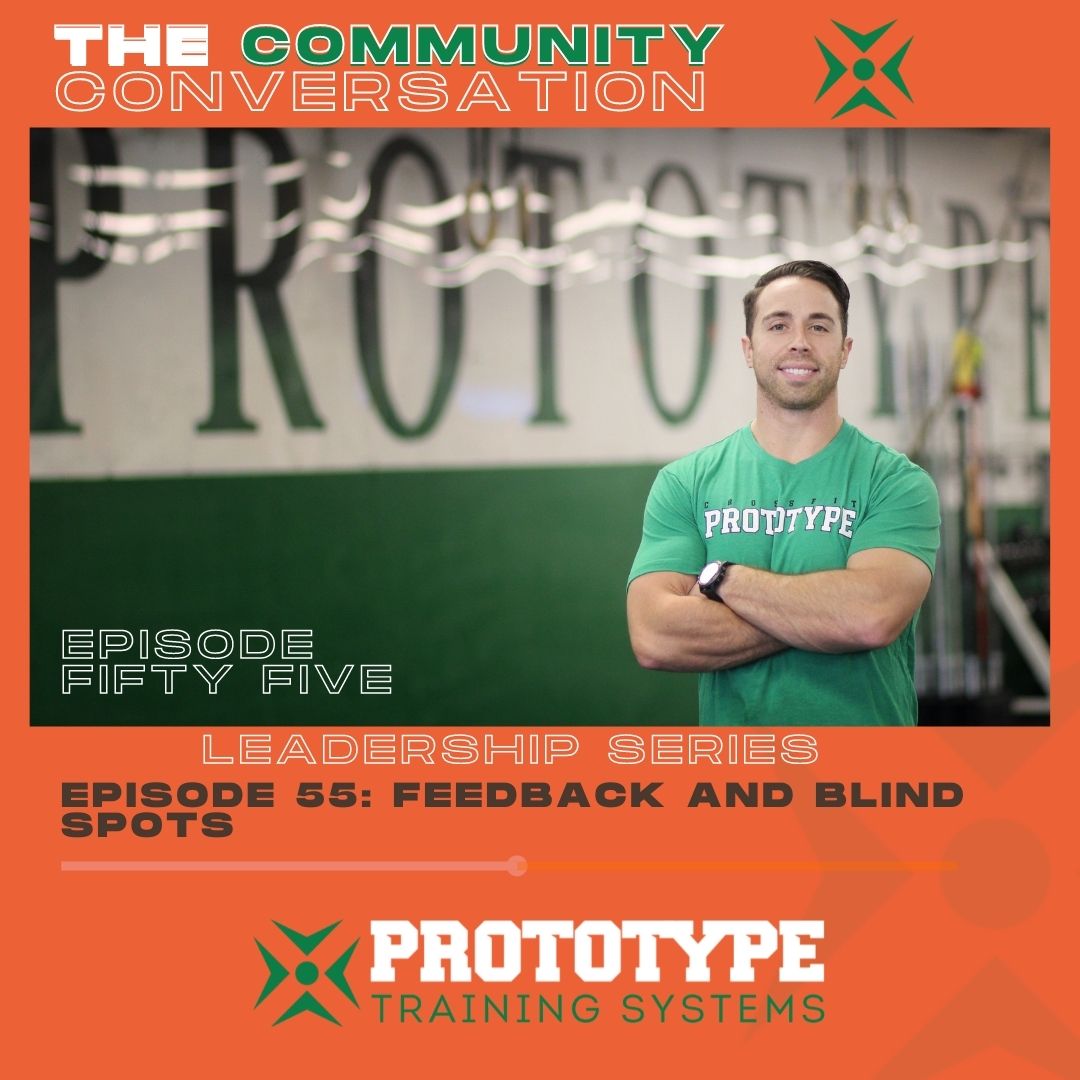
Ep 55: The Community Conversation-Mike Collette Leadership Series (Feedback and Blind Spots)
Thank you for checking out The Community Conversation, brought to you by Prototype Training Systems , home of CrossFit Prototype! The Community Conversation highlights a different member of the Prototype Community each week and allows them to tell their story, share their life experience, and communicate their perspective on all things fitness.
We’ve all listened to podcasts and watched YouTube videos that highlight some of the world’s greatest leaders and visionaries. We believe we have some AMAZING people at Prototype and we want you to get to know them! (Check out our last episode here!)
This is our 55th episode of The Community Conversation and today, Mike Collette continues his Leadership Series with the third episode: Feedback and Blind Spots! You won’t want to miss this episode as it’s a good one!
So, click the link below to watch this Community Conversation on our YouTube page! You can also check out The Community Conversation on all major streaming platforms including Spotify! Don’t forget to subscribe!
Mike Collette 0:02
All right, everyone, welcome back to the community conversation and our leadership series. So past few weeks been doing these leadership, I guess, podcast or talks. And I’ve kind of shared a little bit of my journey and things that we’re doing a prototype recently. But today, what we’re going to be talking about is feedback and blind spots, and so over the last couple of weeks have done a lot of calls with many of you, our members, in regards to feedback on how we’re doing at prototype, what we can be doing better, and all that fun stuff. And I’ve got a lot of great ideas, a lot of great, unfiltered thoughts, and on what we’re doing well, what we’re not doing well. And not only is that refreshing, it just continues to validate this whole idea or notion that we don’t know what we don’t know. And that’s why feedback is so important. So as coaches and trainers, we are constantly giving our clients members athletes feedback, right, so how to do exercises correctly how to which positions to get into evaluating form and technique, giving feedback on, you know, strategy of the workout, intensity of the workout, etc, etc, there’s this constant communication that’s going on. On the other side, from a feedback perspective, there’s communication that can be nonverbal, can be verbal, both that relationship between the member athlete and the coach, but one thing that we started to realize is, as coaches, you know, we give each other a lot of feedback, right, so we have this peer evaluation, sort of system that we do at prototype, and we, we give feedback to each other all the time. And the idea is, we all have blind spots in our coaching and things that we do. And some of us have really good strengths. And some of us have, have apparent weaknesses, that the folks that have strengths in those areas can help build each other up. So the idea is that, if we’re all helping each other get better, we all rise, we all get better together. That’s the whole concept. The thing that I mentioned is that us as coaches, we see things from, from the lens of coaching, and how to make people better how to build better relationships, or not getting that feedback, necessarily all the time from our clients who are members in terms of what we’re doing well, and the experience that they’re having. And it’s something that we’re driving more towards. From a community perspective, prototype is feedback, feedback culture. And so the calls that I had over the last couple of weeks is I’ve been, like I said, really, really refreshing to kind of uncover some of the blind spots that we have, and we all have blind spots. And when it comes to doing things better in life, from being a better leader, to a better athlete, a better coach better, you know, husband, wife, parent, etc, etc. We all have these blind spots, we don’t have the rearview mirrors that we can just look in and see what’s see what’s behind us, right? It’s the things that we can’t see and the things that we may not be self aware of. And the people around us that are closest to us are the ones that are going to be the most honest with us are the ones that can help us see those blind spots, and it’s up to us to put in that effort and time to improve on those areas. based on the feedback that we are receiving. At the end of the day feedback is just an opinion. But if that opinion is, is apparent, and vocalized enough, and from a bunch of different people, it gets us thinking, is that actually true? Is that something that I need to improve on something that I need to address, and some of those things that may be blind spots we may be aware of, but we may not think that it’s a big deal. Right? It’s not something that we need to address or something that you need to improve on. That’s also on us, right? So at the end of the day, having a system or having people that are around you, they’re, they’re trustworthy, they’re honest with you, that can help you improve that will help you improve is such an amazing thing and great thing to have. And again, I’m just so happy to be having these calls with our members and the honesty and level of transparency that that I’ve been receiving. So back to the whole idea of feedback, right? And this concept of blind spots, sometimes when receiving feedback, and it also depends on the person who’s giving it to you the relationship that you have with that person. So it could be like someone very close to you like a parent or a spouse. And the way that they may give you that feedback may hit you pretty hard in the in the gut or may bother you to an extent you kind of brush it, brush it off. It’s such an integral part of like who we are is is people, it’s a skill, just like getting better at double unders getting a better at Olympic lifts to not only give feedback to someone else, but also to receive feedback as well and to take it in and to interpret it as, as information. Versus it’s something that’s attacking our identity or attacking who we are as a person. If we look at things from a narrow lens, and aren’t receptive to the thoughts and opinions of other people, it makes it really, really challenging to not only grow and improve, but it makes it really challenging for others to actually want to give you feedback, right? So an easy example is if someone that’s not very receptive or shuts down, when someone gives them honesty or truth, or someone that just doesn’t listen, isn’t responsive or doesn’t take any advice or feedback that they’re that they’re given the people that are more inclined to give that feedback with the intent, hopefully, the intention is to be helpful. Don’t just stop giving feedback. And that doesn’t help anyone, it doesn’t help you, it doesn’t help them. And it certainly doesn’t help the other people around you that may be thinking those exact same things. So going back to the whole comparison of putting in the reps, you know, Episode One of this leadership, this leadership series, is we have to put in the reps of giving feedback, we also have to get the reps of receiving feedback. And a really interesting exercise that we’ve done recently with a small group with our team is called the red arrow behaviors exercise, what are the things that you may be doing that prevent others from giving you the truth, or what are the things that make it hard for you to receive truth from others. And it’s essentially a self awareness exercise and Episode Two of the leadership series, we really talked about this whole idea of awareness, we have to be aware of what we’re doing. And there’s this level of self awareness that we have, that we know that we’re doing, right the behaviors that you know, you may, you may do on a regular basis, that could be being passive aggressive to someone else, that could be something that you just naturally do, and you’re aware that you do it, but it’s just something that you do, because you can’t control it. Right, we can control it, but it just takes practice, right. But also, this whole concept of lack of awareness and the people that are around you, or that can be the most honest with you can help you see or uncover some other some other layers of awareness that you may be unaware of right and bringing things to light. And that’s where kind of this whole feedback system comes in. So an easy example is, let’s say you come to prototype. And we help we’re starting to help you coach you. And you’ve been doing squats a certain way for your entire life, maybe you had a coach that said, Hey, don’t squat below parallel because it’s bad for your knees. And so you learned that squatting about parallel was the right thing to do. So your entire life, you’d be doing these quarter squats, and then you come to prototype and we say, Hey, listen, like squatting full depth. And below parallel is not only good for your knees, but it’s going to utilize all the musculature of your lower body, working full depth and range of motion is an important thing to do, especially in life. In general, we don’t train in partial range of motions, we don’t live in partial range of motions all the time. So that level of awareness, you are aware, in the beginning, this is how we’re supposed to do some supposed to do something, I’m doing it right, gotten some feedback and doing things a little bit differently. It’s up to you to take that feedback in and to do something with it. And then that kind of brings this notion of coachability. Right? So coachability is like this balance between like humility and, and confidence, how you can take and receive feedback and then put that into action. That’s something that we look at all the time as coaches, when training folks, is that level of someone’s coachability? Are they are they going to listen to things that I say they’re gonna listen to the advisor, or feedback that I give them? Or are they just gonna keep doing the things that they want to do doing things their way, and not really being open minded or open to some of the thoughts from from others. So again, we all have these blind spots, we all have some level of lack of self awareness that we can improve on. We all have things that we can improve on to get better and be better people. But it takes time it takes the reps. It takes the level of It takes people around you giving you that that feedback, it takes a collective group safe group people to kind of be around you can feel confident and you can also trust in to have your best interests in mind. So you know, in this leadership series, you know, something to think about, if you are a manager or a leader in an organization, or just a leader in your community, or parent or just any level of leadership, then you can, you can put that to any context that you that you’d like, is that if you want to be better, if you want to improve, and you know, there’s areas for you to improve, and we talked about, in Episode Two awareness first, right, you need to be self aware of the things that you’re doing that’s preventing others from giving you truth, or the things that you’re doing, that may be impacting others. But we also have to be a little bit more receptive to feedback. And again, it’s a skill, it’s a skill, something that requires practice requires reps, like we talked about in episode one. So with that being said, today’s leadership series, something to think about something to think on a little bit is like who are the people in your life that you trust the most to give you the most honest truth? And when they do, or if you ask for it, or if you don’t ask for it? When was the last time you’ve asked for it? And if it’s if something you haven’t asked for, can you start doing that in a more routine basis, but also start to think about how you react or what you do when getting feedback from others that are close in your life and that can start to bring out some other levels of awareness that you may not be cognizant of. So anyway, this was episode three of our leadership series. Hopefully this starts getting some things stirring in your mind if you have any questions, please don’t ever hesitate to reach out to me. Mike Collette you can shoot me an email at Mike@prototypetraining.com. Happy to talk through anything if you are struggling with anything. If you have more questions on leadership, please do not hesitate to reach out and I appreciate y’all listening and have a great rest of your day.
Transcribed by https://otter.ai
Previous Blogs

Climb to New Heights
Prototype Training Systems is more than a gym - it is a lifestyle. Join us today!